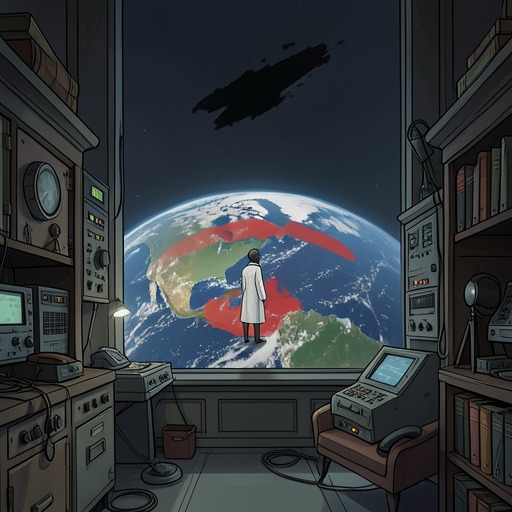
Withdrawal
Stranger in a Strange LandWithdrawal is a deliberate meditative trance through which Mike concentrates on a task or inward process until he has “grokked the fullness.” It can make ordinary time and action seem to recede, but it is not simply an escape from the world: Mike uses withdrawal to handle urgent events, teach Martian language, and bring himself to a point at which he can return to other people and work. Around him, the practice becomes a shared discipline, involving trust, trained collaborators, and a community that must learn when to wait and when to act.
Purpose and Practice
Mike’s withdrawal can be difficult for others to distinguish from an absence that demands intervention. When Jubal arrives wanting to hear directly from him and scold him for the crisis, Ben explains that Mike is meditating and has left instructions that no action be taken. Jubal decides not to interrupt. He knows Mike eventually comes out of self-hypnosis when he has “grokked the fullness”; if he has not reached it, he needs to return to the trance. To Jubal, disturbing him would be as pointless as disturbing a hibernating bear. The episode makes waiting part of the practice: an outsider may be eager for answers, but Mike’s work has its own completion point.
Withdrawal can also extend Mike’s capacity to attend to events beyond the immediate present. As authorities send troop carriers toward the group, he disarms the arriving troops, removes even their shoes, and makes the empty carriers disappear. Ben expects him to remain withdrawn until the authorities tire and give up, reasoning that managing so many details would require Mike to remain in an altered relation to time. Dawn, however, believes he could handle it with far less effort than another person would need. Her comparison underscores the difference between Mike’s scale of attention and ordinary human limits without implying that the work is effortless or unending.
The practice has a social boundary as well as an inward one. Mike leaves instructions while withdrawn, and the people around him respond by protecting the conditions of his work rather than treating his silence as permission to intervene. Jubal’s choice to wait is significant precisely because he is impatient to confront Mike. Withdrawal therefore organizes other people’s conduct: it asks them to accept uncertainty until Mike is ready, while giving them a concrete reason to hold back—the possibility that interrupting him will undo unfinished work.
Teaching and Shared Work
Mike uses withdrawal not only for his own concentration but also as a means of transmitting knowledge. In the work on Martian, he places selected collaborators into a short trance and pours language, definitions, idioms, and concepts into them. The experience lasts only moments in ordinary time but feels to the recipients like hours. They must dictate what they have received at once, while it remains available to recall. The method depends on particular abilities: participants need a clear accent, the capacity to enter the relevant rapport, and the ability to speak the material back accurately. Sam, for example, knows Martian but speaks it with a Bronx accent, making his contribution unsuitable for a dictionary that must avoid errors.
The work is organized around practical needs. Patty, Jill, Maryam, Allie, and others take turns in bedrooms equipped with tape recorders. Allie is still in a semi-trance as she dictates when Jubal is cautioned not to interrupt: she would lose what she has not yet recorded. Mike’s concentrated transmission thus depends on a chain of human actions—receiving, remembering, dictating, recording, and later editing—rather than on the trance alone. Maryam and another collaborator are expected to leave for a quieter place to complete the work, while recorded lectures and language tapes await transcription and publication with the dictionary.
The scale of the undertaking becomes clearer when Mike prepares to free himself for a visit with Jubal. Duke has spent the night searching the city for high-speed tape recorders; everyone capable of helping is being filled with Martian phonetic symbols so that Mike can finish his part and rejoin the group. One participant reports that a brief session gave her about six weeks of subjective time, while the more sustained work is divided among people able to carry it forward. Mike says he has supplied only the primer knowledge he himself possesses; more advanced collaborators will continue the work over a much longer period. The difference between what he can impart at once and what remains to be learned keeps the process from being mistaken for instant mastery of the whole language.
Completion, Return, and Relationship
Withdrawal has an endpoint that matters to Mike as much as its intensity. After completing a job, he stretches and yawns, saying that finishing always feels good. Jubal observes that Mike is likely to take on another task before the day ends, and remarks that the first time in more than two months Mike has simply relaxed and done nothing is notable. The return from withdrawal is therefore not merely the ending of a trance: it restores a person to ordinary company, conversation, and rest, even if that rest may be brief.
Mike also treats the trance as a way to make himself available to others. When Jubal arrives, Mike is withdrawn, but the group explains that he is making a special effort to finish in time to visit him and to let everyone else become free as well. At another point, Mike says that being with Jubal is a great goodness even when nothing is troubling him, and that Jubal is the one human to whom he can always speak without fear of overwhelming him. Jill, Dawn, and Patty understand and care for Mike, but he worries that sharing his hurt would hurt them, or leave them carrying it. His account makes clear that his relationships are not interchangeable: Jubal’s value lies in his capacity to receive what Mike cannot yet share safely with the others.
That personal disclosure leads Mike to consider confession as a practice the church needs to develop more deliberately. Confession exists among the group, but often occurs spontaneously after the pilgrim has already passed the point of needing it. Mike contrasts this with Catholic confession, which has a corps of men to receive it, and with Fosterite group confession, which distributes the burden among participants. He wants the church to provide strong listeners because what a person understands as sin may be disturbing even when it does not involve an actual wrong. Withdrawal and confession are not the same practice, but both address what a person must work through before it can be shared or understood in company.
Significance
The episodes of withdrawal set private concentration against collective dependence. Mike can receive and organize work in a way that no single collaborator can match, yet the results must be spoken, checked, recorded, transcribed, and taught by people with distinct abilities. The language project makes the practice visibly productive, while Jubal’s waiting shows its interpersonal cost: others sometimes have to tolerate silence and postpone the conversation they want.
The novel also refuses to present withdrawal as a simple withdrawal from responsibility. Mike remains accountable to the tasks he has taken on and makes efforts to emerge when other people need him. At the same time, his need to enter the trance and reach fullness cannot be reduced to a timetable imposed by those around him. That tension—between the extraordinary reach of his attention and the limits of what others can demand from him—defines withdrawal as both a private discipline and a condition the community must learn to accommodate.